Ecommerce Marketing Course Jabalpur is a useful search topic for students, entrepreneurs, business owners, and beginners who want to understand how to promote products online. As more businesses explore online selling, learning ecommerce marketing can help you understand how online stores attract customers, promote products, and improve sales opportunities.
Ecommerce marketing involves using digital channels such as search engines, social media, paid advertisements, email, and content marketing to reach potential customers. It also includes product page optimisation, customer retention, conversion tracking, and understanding online shopping behaviour.
Whether you want to market your own online store, work with an ecommerce brand, or develop digital marketing skills, learning the fundamentals can be a practical starting point.
An Ecommerce Marketing Course Jabalpur can help beginners understand how online stores attract customers through SEO, social media marketing, paid advertising, and content creation.
What Is Ecommerce Marketing?
Ecommerce marketing is the process of promoting an online store and its products to attract visitors, encourage purchases, and build long-term customer relationships.
For example, imagine a business selling clothing, beauty products, electronics, or handmade gifts online. The business needs customers to discover its products, understand their benefits, trust the brand, and complete their purchases.
Ecommerce marketing can support these goals through several channels:
- Search Engine Optimization (SEO): Helping product and category pages appear in relevant organic search results.
- Social Media Marketing: Promoting products through content, Reels, and community engagement.
- Paid Advertising: Using platforms such as Google Ads and Meta Ads to reach relevant audiences.
- Content Marketing: Publishing useful guides, product comparisons, and buying advice.
- Email Marketing: Sharing product updates, offers, and customer communications.
- Conversion Rate Optimization: Improving the shopping experience so more suitable visitors complete desired actions.
- Analytics: Measuring traffic, sales, advertising costs, and customer behaviour.
A good ecommerce marketing learning path should explain how these activities work together rather than treating each channel as an isolated skill.
Why Learn Ecommerce Marketing in Jabalpur?
Ecommerce marketing skills can be useful for businesses of different sizes, including local retailers exploring online sales and established online stores looking to improve their digital presence.
Learning ecommerce marketing may help you:
- Understand how online stores attract potential customers.
- Learn how to promote products through search engines and social media.
- Understand the basics of online advertising.
- Improve product descriptions and landing pages.
- Measure marketing performance using relevant data.
- Explore freelance, employment, or business applications of your skills.
For entrepreneurs in Jabalpur, ecommerce marketing can also provide a framework for exploring how local products may reach customers beyond their immediate area. Success depends on factors such as product demand, pricing, delivery, customer service, competition, and marketing execution.
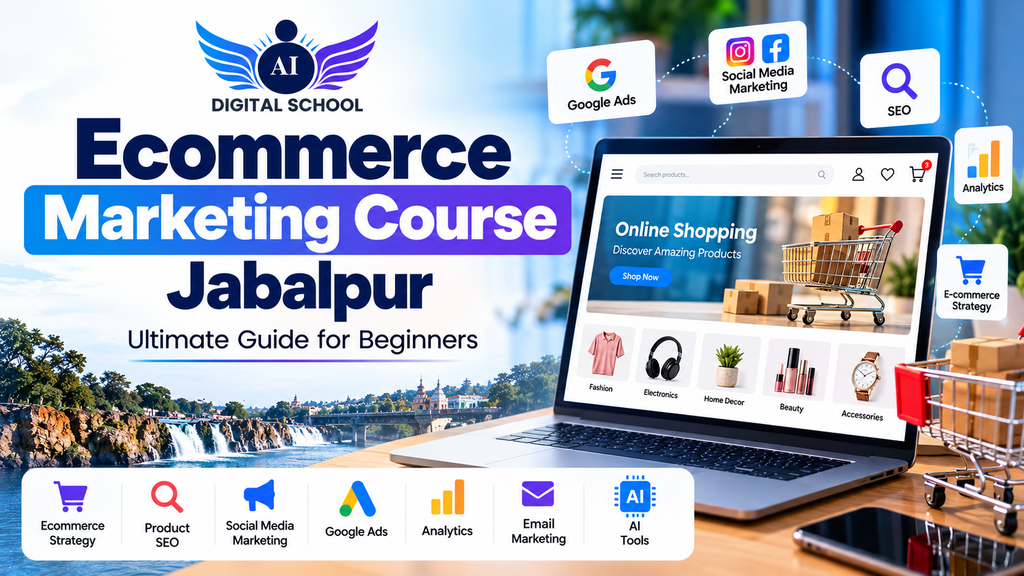
Ecommerce Marketing Course Jabalpur: Important Modules to Learn
1. Ecommerce and Digital Marketing Fundamentals
Begin by understanding how an online business operates and how marketing supports its goals.
Topics may include:
- Introduction to ecommerce business models
- Online marketplaces versus independent websites
- Target audience and customer personas
- Customer journey and buying behaviour
- Brand positioning and product differentiation
- Marketing funnels
- Organic versus paid marketing
- Ecommerce marketing objectives
Practical exercise: Choose a product category, such as clothing or home decor. Identify the target customer, the product’s main benefits, competing products, and suitable marketing channels.
This exercise will help you understand the business side of ecommerce before moving to individual marketing tools.
2. Ecommerce SEO and Product Page Optimisation
Search Engine Optimization helps online stores attract relevant visitors through organic search. Product and category pages should provide useful information that matches what customers are looking for.
An ecommerce SEO module may cover:
- Product keyword research
- Search intent
- Product titles and descriptions
- Category page optimisation
- Image alt text
- Internal linking
- Technical SEO fundamentals
- Duplicate content considerations
- Structured data basics
- Google Search Console
Practical exercise: Create an example product page with a descriptive title, useful product information, relevant keywords, image alt text, and a clear call to action.
Remember that SEO is a long-term process. Rankings and traffic depend on many factors, and no course can guarantee specific search positions.
3. Social Media Marketing for Ecommerce
Social media can help online stores introduce products, demonstrate how they work, answer customer questions, and build brand recognition.
Important topics include:
- Instagram and Facebook marketing
- Product-focused content planning
- Reels and short-form videos
- Product photography and creative concepts
- Caption writing
- Social media calendars
- Audience engagement
- Influencer marketing fundamentals
- Social media performance metrics
Practical exercise: Plan seven days of content for an online store. Include product demonstrations, frequently asked questions, educational posts, customer concerns, and promotional content.
The objective is to develop content that informs potential customers and supports their buying decisions.
4. Google Ads and Meta Ads for Online Stores
Paid advertising can help ecommerce businesses introduce products to relevant audiences and measure campaign performance.
A course may introduce:
- Google Ads campaign fundamentals
- Search advertising
- Shopping campaign concepts
- Meta Ads for Facebook and Instagram
- Audience targeting
- Ad creative and copywriting
- Campaign budgeting and bidding
- Conversion tracking
- Remarketing concepts
- Return on ad spend (ROAS)
Practical exercise: Prepare a sample advertising plan for an online store. Define the campaign objective, audience, product offer, creative idea, landing page, and proposed budget.
Learn the basics of tracking purchases and advertising costs before running live campaigns. Advertising performance varies, and sales are never guaranteed.
5. Ecommerce Website and Store Fundamentals
Marketing works best when customers can easily understand products and complete their purchases. Learning how an online store is structured can help marketers identify improvements.
Topics may include:
- Ecommerce website structure
- Product and category pages
- Product descriptions and images
- Navigation and site search
- Mobile-friendly shopping experiences
- Shopping cart and checkout basics
- Payment and shipping information
- Trust signals and customer support
- Landing page optimisation
- Website performance fundamentals
Practical exercise: Review a sample online store and identify five improvements that could make its product information clearer or its shopping process easier to use.
Depending on the programme, learners may also explore WordPress and WooCommerce or other ecommerce platforms.
6. Content Marketing and Product Copywriting
Customers often compare products before purchasing. Useful content can answer their questions and help them understand which products suit their needs.
Learn about:
- Product description writing
- Product benefits and features
- Buying guides
- Product comparison articles
- Frequently asked questions
- Blog content planning
- Search-friendly headings
- Calls to action
- Content repurposing
Practical exercise: Write a product description and a short buying guide for the same product. Make the description clear and specific, and ensure the buying guide addresses common customer questions.
Avoid unsupported product claims and copied descriptions. Accurate, original information helps customers make informed decisions.
7. Email Marketing and Customer Retention
Ecommerce marketing does not end when someone visits a store. Businesses may also need to communicate with customers after purchases and encourage repeat engagement.
A beginner-friendly module may cover:
- Email list management
- Newsletter creation
- Welcome email concepts
- Product update emails
- Order-related communications
- Customer segmentation
- Repeat-purchase campaigns
- Consent and unsubscribe practices
- Email performance metrics
Practical exercise: Design a sample newsletter for an online store featuring a new product, useful information, and a clear link to the relevant product page.
Use appropriate consent practices and follow applicable privacy requirements when working with customer data.
8. Ecommerce Analytics and AI Tools
Analytics helps businesses understand which marketing activities are producing useful results. AI tools can support research, content planning, and repetitive workflows.
Important topics may include:
- Website traffic sources
- Product page engagement
- Conversion rate
- Average order value
- Customer acquisition cost
- Return on ad spend
- Google Analytics fundamentals
- Campaign reporting
- AI-assisted product content
- AI creative and content ideas
- Marketing automation concepts
Practical exercise: Build a simple spreadsheet to track website visits, orders, conversion rate, advertising spend, and revenue using sample data.
AI-generated product descriptions, advertisements, and recommendations should be reviewed for accuracy and originality before publication.
Who Should Learn Ecommerce Marketing?
An ecommerce marketing learning programme may be useful for:
- Students and fresh graduates
- Entrepreneurs planning to sell products online
- Retailers exploring digital sales channels
- Digital marketing beginners
- Freelancers interested in ecommerce clients
- Social media managers working with product-based brands
- Business owners who want to understand online promotion
You do not need to master every marketing channel before starting. Begin with the fundamentals, practise with sample projects, and gradually build more specialised skills.
How to Choose an Ecommerce Marketing Course in Jabalpur
Before enrolling, compare programmes carefully. A useful course should explain the concepts, provide opportunities for practice, and help you understand how marketing decisions affect business goals.
Consider these questions:
- Does the syllabus cover ecommerce SEO and product marketing?
- Will you learn the basics of Google Ads and Meta Ads?
- Are website optimisation and analytics included?
- Does the course offer practical assignments or projects?
- Can you ask questions and receive feedback?
- Are the course duration, fees, and learning format clearly explained?
- Does the curriculum include relevant AI tools?
- Are certification and placement-related terms explained accurately?
Choose a course based on your learning goals, the quality of its curriculum, and the practical experience it provides—not just promotional claims.
Learn Digital Marketing at AI Digital School in Jabalpur
AI Digital School provides digital marketing education in Jabalpur, covering learning areas such as SEO, social media marketing, PPC advertising, content marketing, website designing, email marketing, and AI tools.
These skills can provide a foundation for understanding ecommerce promotion, although you should confirm whether a dedicated ecommerce marketing module or course is currently available.
If your goal is to market an online store, ask about product page optimisation, ecommerce advertising, conversion tracking, analytics, and practical ecommerce projects before choosing a programme.
You can explore the available courses and request current syllabus details through the official website:
Visit: https://aidigitalschool.in/
Frequently Asked Questions
1. What is an ecommerce marketing course?
An ecommerce marketing course teaches methods used to promote online stores and products. Topics may include ecommerce SEO, social media marketing, paid advertising, product content, email marketing, and analytics.
2. Can beginners learn ecommerce marketing?
Yes. Beginners can start with digital marketing fundamentals and gradually learn product promotion, ecommerce SEO, advertising, and performance measurement through practical exercises.
3. Is ecommerce marketing useful for small businesses?
It can help small businesses understand how to promote products online, reach relevant audiences, and measure marketing performance. Results depend on product demand, competition, pricing, customer experience, and execution.
4. Does ecommerce marketing include Google Ads?
Many ecommerce marketing programmes introduce Google Ads and other paid advertising methods. Check the specific syllabus to confirm whether Shopping campaigns, conversion tracking, and remarketing are included.
5. Where can I learn ecommerce marketing in Jabalpur?
You can explore digital marketing training options at AI Digital School in Jabalpur and ask about its current ecommerce-related modules, practical projects, course duration, and fees.
6. Do I need a website to learn ecommerce marketing?
No. You can begin by studying product promotion and advertising concepts using sample projects. However, understanding ecommerce websites, product pages, and checkout processes is useful for developing broader ecommerce marketing skills.
Conclusion
An Ecommerce Marketing Course Jabalpur can be a useful starting point for people who want to understand online product promotion and ecommerce growth strategies.
By learning ecommerce SEO, social media marketing, Google Ads, product copywriting, website fundamentals, email marketing, analytics, and AI tools, you can develop a foundation for working with online stores or promoting your own products.
Start by understanding the fundamentals, practise with realistic projects, and choose a course that matches your goals.
Ready to build your digital marketing skills? Visit AI Digital School to explore available programmes and ask about ecommerce marketing topics, practical assignments, and the current syllabus.