How to Start Learning Digital Marketing from Scratch is a common question among students, job seekers, business owners, and aspiring freelancers who want to build valuable digital skills.
As businesses increasingly use online platforms to reach customers, digital marketing has become an important part of modern business growth.The good news is that you do not need advanced technical knowledge or years of experience to begin. With the right learning roadmap, consistent practice, and access to useful tools, you can start developing digital marketing skills even if you are a complete beginner.
In this guide, you will learn what digital marketing is, which skills you should learn first, how to practise with real projects, which AI tools can help you, and how to explore career opportunities.
At AI Digital School, the goal is to help learners understand practical digital skills and apply them to real-world projects.If you want to know How to Start Learning Digital Marketing from Scratch, begin with the fundamentals, choose one skill at a time, and practise through real-world projects. This approach helps beginners build confidence and develop practical marketing knowledge.
What Is Digital Marketing?
Digital marketing is the process of promoting products, services, brands, or businesses through digital channels such as search engines, websites, social media, email, and online advertising platforms.
Traditional marketing often uses newspapers, television, radio, or printed advertisements. Digital marketing allows businesses to connect with audiences online, measure campaign performance, and improve their strategies using data. Understanding the basics is the first step in learning how to start learning digital marketing from scratch. Once you know how online marketing works, you can choose the right skills and begin practising with simple projects.
Some common examples of digital marketing include:
- Search Engine Optimization (SEO) to improve website visibility.
- Social media marketing to build an audience and engage customers.
- Google Ads to reach people searching for particular products or services.
- Content marketing to educate and attract potential customers.
- Email marketing to communicate with subscribers.
- Website marketing to convert visitors into leads or customers.
- AI-assisted marketing to support research, content creation, and campaign planning.
For example, a local business in Jabalpur can use a website, Google Business Profile, Instagram content, and targeted advertising to attract customers from nearby areas.
Step 1: Understand the Fundamentals of Digital Marketing
Before learning advanced tools, understand how digital marketing works as a complete system.
Start by learning the customer journey: awareness, consideration, conversion, and retention. A potential customer may discover a business through a Google search, visit its website, compare services, and eventually contact the business through WhatsApp.
You should also understand these basic concepts:
- Target audience: The people most likely to need your product or service.
- Marketing objective: The result you want, such as website traffic, leads, sales, or brand awareness.
- Conversion: A valuable action, such as a purchase, enquiry, registration, or phone call.
- Call to action (CTA): A message encouraging people to take the next step.
- Marketing analytics: Measuring results to understand what is working.
These fundamentals help you make better marketing decisions instead of simply posting content or running advertisements without a clear purpose.
Step 2: Learn Search Engine Optimization (SEO)
Search Engine Optimization helps improve a website’s visibility in unpaid search results. It is a useful starting point for beginners because it teaches you how people search for information and how websites organise their content.
Focus on the following SEO skills:
Keyword research: Learn how to identify search terms people use when looking for information, products, or services.
On-page SEO: Understand page titles, meta descriptions, headings, internal links, URLs, and image alt text.
Technical SEO: Learn the basics of website indexing, mobile usability, page speed, and crawlability.
Content SEO: Create useful articles that answer searchers’ questions and match their intent.
Local SEO: Learn how businesses can improve their visibility in local search results using accurate business information, relevant website content, and customer reviews.
You can practise SEO by creating a simple website or blog and publishing helpful content. Use Google Search Console to monitor search visibility and identify opportunities for improvement.
Remember that SEO takes time. Rankings and traffic are not guaranteed, so focus on useful content and sustainable optimisation rather than shortcuts.
Step 3: Develop Social Media Marketing Skills
Social media marketing helps businesses build relationships with audiences, share content, promote products, and generate enquiries.
Start by understanding the platforms that match your audience and goals. Instagram can support visual content and Reels, Facebook can help businesses reach communities and customers, LinkedIn is useful for professional audiences, and YouTube supports longer videos and Shorts.
Learn these essential skills:
- Content planning and calendar creation.
- Writing captions, hooks, and calls to action.
- Designing posts, carousels, and promotional creatives.
- Creating short-form videos and Reels.
- Understanding audience engagement and insights.
- Analysing reach, watch time, clicks, and enquiries.
For practice, select a business category such as a coaching institute, restaurant, clothing store, or interior design company. Create a seven-day content calendar and prepare sample posts for that business.
This exercise will help you understand how content supports business objectives.
Step 4: Learn Website Design and Content Creation
A website acts as a digital home for many businesses. It can explain services, showcase products, collect leads, publish articles, and provide contact information.
You do not need to become a professional programmer before starting digital marketing. You can begin by learning basic website structure and using platforms such as WordPress.
Learn how to:
- Create essential pages such as Home, About, Services, Blog, and Contact.
- Organise content with clear headings and navigation.
- Design mobile-friendly layouts.
- Add enquiry forms and WhatsApp contact options.
- Publish SEO-friendly blog posts.
- Connect website analytics and search performance tools.
Content creation is equally important. Practise writing informative articles, designing graphics, editing short videos, and developing simple promotional campaigns.
The objective is not just to make content look attractive. Each piece of content should serve a purpose, such as educating an audience, building trust, attracting traffic, or generating enquiries.
Step 5: Understand Google Ads and Paid Advertising
SEO and organic social media can help attract audiences over time. Paid advertising allows businesses to promote their offers to selected audiences through platforms such as Google Ads and Meta Ads.
As a beginner, first understand the difference between search advertising, display advertising, video advertising, and social media campaigns.
Then learn the basic elements of a campaign:
- Campaign objectives and audience selection.
- Keyword and search intent research.
- Ad copy and creative development.
- Budgeting and bidding basics.
- Landing page optimisation.
- Conversion tracking and performance analysis.
For example, a digital marketing institute could create a campaign targeting people searching for a digital marketing course in Jabalpur. The advertisement could direct users to a relevant landing page with course details and an enquiry form.
Start with practice exercises or simulated campaigns. If you eventually run live campaigns, use a controlled budget and establish tracking before spending money. Never assume that advertising automatically guarantees leads or sales.
Step 6: Use AI Tools to Learn Faster
AI tools can support digital marketing work by helping with research, brainstorming, content outlines, creative concepts, and reporting. Learning to use them responsibly can make your workflow more efficient. For beginners exploring how to start learning digital marketing from scratch, AI tools can simplify brainstorming, content planning, and research. Always review AI-generated suggestions and verify information before using it.
Beginners can explore tools such as:
- ChatGPT: Brainstorming, content outlines, keyword ideas, campaign concepts, and draft creation.
- Canva: Social media graphics, presentations, and marketing creatives.
- Google Analytics: Understanding website traffic and user behaviour.
- Google Search Console: Monitoring search performance and indexing.
- Video editing tools: Creating short-form promotional videos and social media content.
AI-generated content should always be reviewed for accuracy, originality, relevance, and brand consistency. Do not publish unverified facts or upload confidential customer information to tools without appropriate permission and safeguards.
A practical exercise is to use an AI assistant to brainstorm ten blog topics, refine one topic into an outline, write a draft, fact-check it, and optimise it for readers and search intent.
AI should support your thinking and creativity rather than replace your judgement.
Step 7: Practise With Real Projects
One of the most important parts of learning digital marketing from scratch is practical experience. Knowing definitions is useful, but applying them to a real problem helps you develop confidence.
You can start with these beginner-friendly projects:
Project 1: Build a simple website. Create a basic website for a fictional business and write its Home, About, and Services pages.
Project 2: Create an SEO blog. Research a topic, identify relevant keywords, write a helpful article, and optimise its title, headings, URL, and meta description.
Project 3: Plan social media content. Prepare seven posts with captions, visual concepts, and clear calls to action.
Project 4: Design an advertising campaign. Write sample Google Ads or Meta Ads copy and create a suitable landing page concept.
Project 5: Prepare a performance report. Use sample data to explain traffic, engagement, clicks, leads, and conversions.
Save your work in a portfolio. Clearly label practice projects as sample work and distinguish them from campaigns you have actually managed for clients.
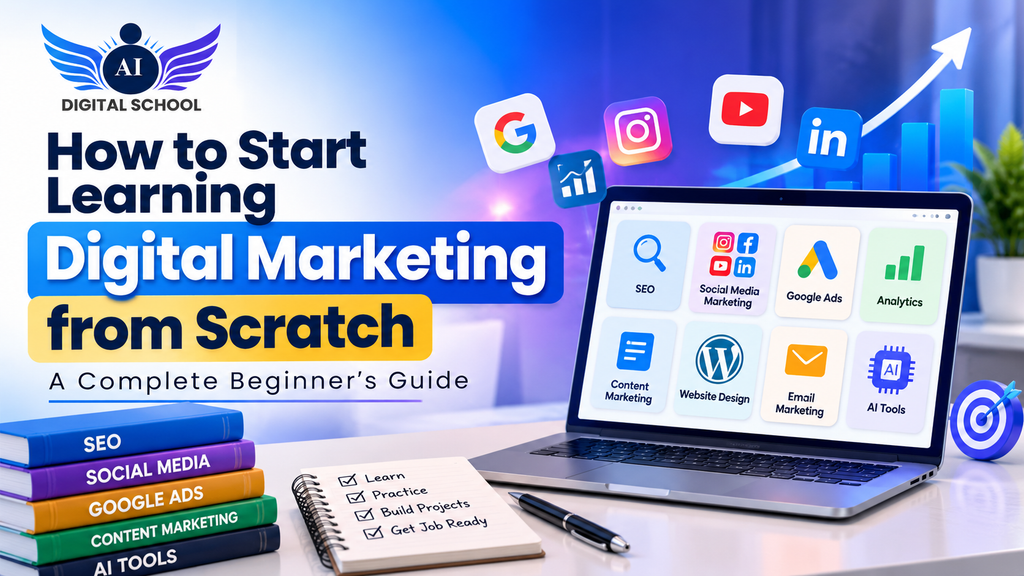
A structured roadmap makes it easier to understand How to Start Learning Digital Marketing from Scratch without feeling overwhelmed. Divide your learning into SEO, social media marketing, website development, paid advertising, analytics, and AI tools.
Step 8: Follow a 30-Day Digital Marketing Learning Plan
A simple schedule can help you stay consistent without feeling overwhelmed.
Days 1–5: Fundamentals
Learn digital marketing terminology, customer journeys, target audiences, and marketing objectives.
Days 6–10: SEO
Study keyword research, on-page SEO, search intent, and basic website optimisation. Prepare a sample blog post.
Days 11–15: Social Media
Learn content planning, graphic design, captions, short videos, and social media analytics. Create a sample content calendar.
Days 16–20: Websites and Content
Build a basic website or landing page and practise publishing SEO-friendly content.
Days 21–25: Paid Ads and Analytics
Understand campaign structures, audience targeting, advertising budgets, and performance metrics. Use practice exercises rather than spending money immediately. Learning how to start learning digital marketing from scratch becomes easier when you follow a clear roadmap. Combine SEO practice, social media content creation, website projects, and analytics to build practical skills and track your progress.
Days 26–30: AI and Portfolio
Explore AI-assisted workflows, complete a small project, organise your portfolio, and review what you have learned.
This plan gives you a starting point, not mastery of every digital marketing discipline. Continue practising and deepen your knowledge in the areas most relevant to your goals.
Step 9: Explore Digital Marketing Career Opportunities
Once you have developed foundational skills and completed practical projects, you can explore different career paths.
Possible roles include:
- Digital Marketing Executive.
- SEO Executive.
- Social Media Executive.
- Content Marketing Assistant.
- Performance Marketing Trainee.
- Website Content Specialist.
- Freelance Digital Marketer.
You can also apply these skills to your own business or help local businesses improve their online presence.
Your first opportunity may come from an internship, an entry-level role, a personal project, or a small business assignment. Your portfolio, communication skills, problem-solving ability, and willingness to learn can help demonstrate your potential.
Income varies by location, experience, specialisation, employer, and client demand. Avoid relying on guaranteed salary or earning claims when choosing a course or career path.
Common Mistakes Beginners Should Avoid
When learning digital marketing, try to avoid these common mistakes:
- Learning everything at once: Start with fundamentals and progress one skill at a time.
- Ignoring practical work: Apply each new concept through small projects.
- Chasing instant results: SEO, audience building, and professional development take time.
- Copying content blindly: Develop original work suited to the target audience.
- Ignoring analytics: Learn to measure meaningful results rather than focusing only on likes or views.
- Using AI without checking: Verify information and edit generated content before publishing.
- Expecting guaranteed income: Build skills, experience, and a credible portfolio before making financial assumptions.
Consistent practice and regular feedback are more valuable than simply collecting certificates without applying what you learn.
Why Choose AI Digital School?
If you prefer structured guidance rather than learning entirely on your own, AI Digital School can be a starting point for exploring digital marketing education in Jabalpur.
When evaluating a course, look for a curriculum that covers SEO, social media marketing, website development, paid advertising, analytics, content creation, and relevant AI tools.
Also ask about practical assignments, instructor guidance, portfolio development, course duration, fees, and the support available to learners. Choose a programme that matches your current skill level and career goals.
You can visit the AI Digital School website at https://aidigitalschool.in/ to explore available learning resources and course information.
The right learning environment should help you understand concepts, practise consistently, and develop skills that you can apply to real marketing challenges.
Frequently Asked Questions (FAQs)
1. Can I learn digital marketing from scratch?
Yes. Beginners can start with fundamental concepts and gradually learn SEO, social media marketing, website content, paid advertising, and analytics. Regular practice is essential.
2. How long does it take to learn digital marketing?
You can learn foundational concepts in a few weeks with consistent study. Developing job-ready skills and practical experience generally requires additional practice over several months, depending on your learning pace and goals.
3. Do I need coding skills to learn digital marketing?
No. Most beginner digital marketing activities do not require coding. Basic HTML and website knowledge can be helpful, particularly for technical SEO and website customisation.
4. Can I learn digital marketing for free?
Yes. You can begin with free educational resources, documentation, practice websites, and learning materials from platforms such as Google Skillshop and Google Search Central.
5. Which digital marketing skill should I learn first?
Begin with digital marketing fundamentals, then explore SEO and content creation. After understanding the basics, expand into social media, paid advertising, analytics, and AI-assisted workflows.
6. Is digital marketing a good career option?
It can be a valuable career path for people interested in business, technology, creativity, and data. Opportunities depend on your skills, practical experience, communication, and the needs of employers or clients. If you are deciding how to start learning digital marketing from scratch, focus on one skill, practise consistently, and build a portfolio that demonstrates your progress.
Conclusion
Learning digital marketing does not require you to know everything on your first day. The best approach is to understand the fundamentals, select one skill to practise, complete small projects, and gradually expand your knowledge.
If you are wondering how to start learning digital marketing from scratch, begin today with a simple goal: understand the basics, create your first project, and measure what you learn. Over time, build a portfolio that demonstrates your practical abilities.
Whether you want to pursue a job, start freelancing, promote your own business, or explore digital marketing training in Jabalpur, consistency and hands-on learning will help you move forward.The best way to understand How to Start Learning Digital Marketing from Scratch is to combine consistent learning with practical experience. Start with small projects, measure your results, and improve your skills step by step with AI Digital School.
Start small, practise regularly, and keep improving your digital skills with AI Digital School.