Have you ever searched for a product or service on Google and noticed sponsored websites appearing at the top of the search results? Those advertisements are often created using Google Ads, one of the most widely used online advertising platforms for businesses.
Today, businesses want to reach customers who are actively searching for their products and services. Google Ads helps advertisers connect with these potential customers through search results, websites, YouTube, and other Google advertising placements.
Learning paid advertising can be a valuable skill for students, freelancers, business owners, and aspiring digital marketers.
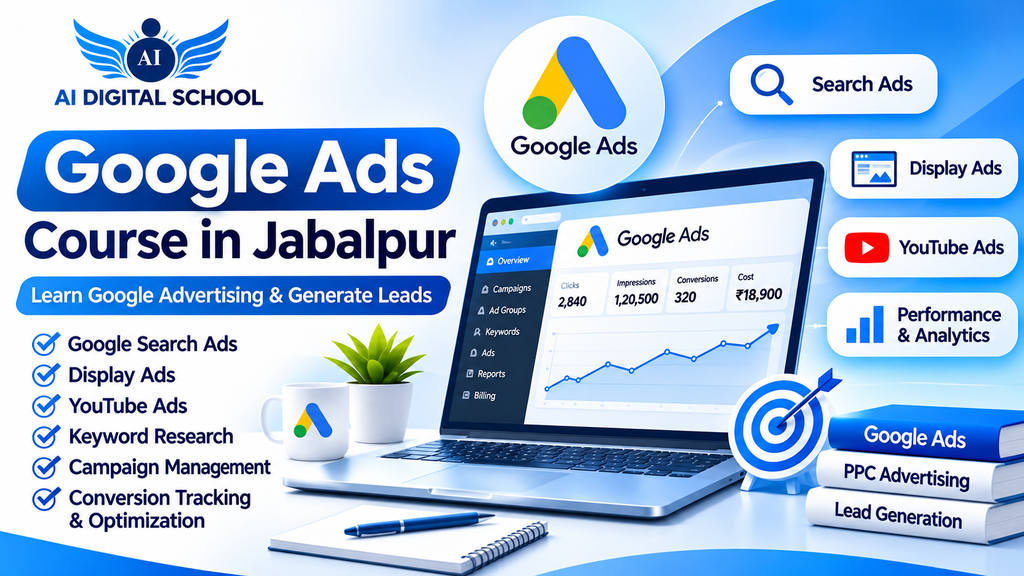
A Google Ads Course in Jabalpur can help beginners understand how online advertising works, how to create campaigns, select relevant keywords, manage budgets, and measure advertising performance.
Whether you want to start a digital marketing career, promote your own business, or offer advertising services to clients, this guide will help you understand Google Ads and the skills you need to learn.
What Is Google Ads?
Google Ads is Google’s online advertising platform that allows businesses and advertisers to promote products, services, websites, applications, and brands.
Advertisers can create campaigns to reach audiences based on factors such as search queries, interests, locations, and other available targeting options.
For example, imagine someone searches for “best digital marketing course in Jabalpur” on Google. An institute running a relevant Search Ads campaign may have an opportunity to display its advertisement to that person.
Google Ads offers different campaign types for different advertising objectives.
Some common campaign types include:
- Search Ads: Text advertisements that can appear on Google Search results.
- Display Ads: Visual advertisements shown across eligible websites and apps.
- Video Ads: Advertisements that appear on YouTube and eligible video placements.
- Shopping Ads: Product advertisements that display product information for eligible retailers.
- App Campaigns: Campaigns designed to promote mobile applications.
- Performance Max: Goal-based campaigns that can access multiple Google advertising channels through a single campaign.
The right campaign type depends on the business objective, target audience, available creative assets, and advertising budget.
Why Is Google Ads Important for Businesses?
Traditional marketing methods often reach broad audiences, while online advertising allows businesses to reach people using more specific targeting options.
Google Ads can help businesses connect with potential customers when they are researching products, comparing services, or looking for solutions.
Here are some important benefits:
1. Reach Customers with Purchase Intent
Search advertising allows businesses to reach users searching for relevant products and services. This can be useful when potential customers already have an interest in what a business offers.
2. Generate Business Leads
Businesses can use Google Ads to encourage visitors to call, submit enquiry forms, request quotations, or contact them through their websites.
3. Promote Local Businesses
Location targeting can help businesses reach relevant audiences in selected cities, areas, and service locations.
4. Control Advertising Budgets
Advertisers can set campaign budgets and manage spending according to their marketing requirements.
5. Measure Campaign Performance
Google Ads provides performance information such as impressions, clicks, conversions, and cost-related metrics.
6. Reach Different Audiences
Businesses can use different campaign types to reach audiences through search, video, display, shopping, and other eligible placements.
Why Learn Google Ads in Jabalpur?
Businesses in Jabalpur are increasingly exploring online platforms to promote their services and connect with potential customers.
Industries such as education, real estate, healthcare, hospitality, retail, and professional services can use online advertising to reach relevant audiences.
Learning Google Ads in Jabalpur can help you understand how to create advertising campaigns for local businesses as well as companies operating across India.
Some reasons to learn Google Ads include:
- Develop practical paid advertising skills.
- Understand keyword research and search intent.
- Learn how to create Google Search campaigns.
- Explore YouTube and Display advertising.
- Understand campaign budgets and bidding.
- Learn conversion tracking and reporting.
- Explore freelancing and professional opportunities.
- Promote your own business more effectively.
What Will You Learn in a Google Ads Course?
A beginner-friendly Google Ads training program should cover advertising fundamentals, campaign setup, keyword research, audience targeting, optimization, and performance measurement.
Here is a suggested learning roadmap.
Module 1: Introduction to Google Ads
Understand the basics of online advertising and how Google’s advertising platform works.
Topics include:
- What is Google Ads?
- Introduction to PPC advertising
- How Google Ads works
- Google Ads account structure
- Understanding campaigns, ad groups, and ads
- Introduction to advertising objectives
- Organic search vs paid search
- Understanding impressions, clicks, and conversions
Module 2: Google Ads Account Setup
Learn how to access and organize your Google Ads account.
Topics include:
- Creating a Google Ads account
- Understanding the Google Ads dashboard
- Account settings
- Billing and payment basics
- Campaign organization
- Linking relevant Google services
- Understanding account access and permissions
Module 3: Keyword Research for Google Ads
Keyword research is an important part of Search Ads because it helps advertisers understand what potential customers are searching for.
Topics include:
- Understanding keywords and search intent
- Short-tail and long-tail keywords
- Commercial and transactional keywords
- Google Keyword Planner
- Search volume and competition
- Keyword selection
- Match types
- Negative keywords
- Search terms analysis
Module 4: Google Search Ads Campaign
Learn how to create text advertisements for relevant Google Search queries.
Topics include:
- Creating a Search campaign
- Selecting campaign objectives
- Choosing locations and languages
- Selecting keywords
- Creating responsive search ads
- Writing headlines and descriptions
- Using relevant landing pages
- Understanding ad relevance
- Campaign settings
Module 5: Google Display Ads
Understand how visual advertisements can help businesses reach audiences across eligible websites and apps.
Topics include:
- Introduction to Display advertising
- Display campaign setup
- Image advertisement formats
- Audience targeting
- Placement targeting
- Remarketing fundamentals
- Creative selection
- Display campaign performance
Module 6: YouTube Ads
Learn how businesses can use video advertisements to promote products, services, and brands.
Topics include:
- Introduction to YouTube advertising
- Video campaign objectives
- Video ad formats
- Audience targeting
- Location and demographic targeting
- Video creative planning
- YouTube campaign setup
- Video campaign measurement
Module 7: Bidding and Budget Management
Learn how Google Ads bidding works and how advertisers can manage campaign spending.
Topics include:
- Understanding advertising budgets
- Cost-per-click (CPC)
- Cost-per-thousand impressions (CPM)
- Cost per acquisition (CPA)
- Manual and automated bidding concepts
- Maximize Clicks
- Maximize Conversions
- Target CPA
- Target ROAS
- Budget allocation
The availability of specific bidding strategies depends on campaign type, settings, and eligibility.
Module 8: Conversion Tracking and Analytics
Advertising performance should be measured through meaningful business outcomes rather than clicks alone.
Topics include:
- What is conversion tracking?
- Understanding conversion actions
- Website form submissions
- Phone call conversions
- Purchase tracking
- Google Ads conversion setup
- Google Analytics 4 introduction
- Campaign performance reports
- Understanding cost per conversion
Module 9: Google Ads Campaign Optimization
Learn how to evaluate campaigns and identify opportunities for improvement.
Topics include:
- Monitoring campaign performance
- Search terms analysis
- Adding negative keywords
- Improving ad copy
- Landing page relevance
- Budget adjustments
- Keyword performance analysis
- Conversion rate analysis
- Identifying underperforming campaigns
Module 10: AI Tools for Google Ads
Artificial Intelligence can support the advertising workflow by helping marketers research, brainstorm, and improve campaign assets.
Topics include:
- ChatGPT for advertising ideas
- AI-assisted headline writing
- Generating ad descriptions
- Landing page content ideas
- Audience research support
- Creative brainstorming
- Performance report summaries
- AI-assisted campaign planning
AI-generated advertising content should be reviewed for accuracy, relevance, brand consistency, and Google Ads policy compliance.
How to Create a Google Ads Campaign: Step-by-Step
If you are a beginner, follow this simplified process to understand how a Search Ads campaign is created.
Step 1: Define Your Advertising Goal
Decide what you want to achieve. Your objective could be website traffic, phone calls, enquiries, purchases, or another business outcome.
Step 2: Understand Your Target Audience
Identify the people you want to reach. Consider their location, interests, needs, and search behaviour.
Step 3: Conduct Keyword Research
Use Google Keyword Planner and other research methods to identify relevant search terms.
Step 4: Create a Campaign
Select an appropriate campaign type and configure the campaign settings according to your advertising goal.
Step 5: Select Keywords and Ad Groups
Organize related keywords into relevant ad groups. Use suitable match types and consider negative keywords.
Step 6: Write Your Advertisements
Create relevant headlines and descriptions that communicate the product or service benefits clearly.
Step 7: Select a Landing Page
Send users to a relevant website page that provides the information promised in the advertisement.
Step 8: Set Your Budget and Bidding Strategy
Choose an appropriate budget and bidding strategy based on your objectives and campaign requirements.
Step 9: Configure Conversion Tracking
Set up suitable conversion actions to measure meaningful results such as calls, enquiries, or purchases.
Step 10: Monitor and Optimize
Review campaign performance regularly and make improvements based on data.
Google Ads vs SEO: What Is the Difference?
Google Ads and Search Engine Optimization both help businesses gain visibility on Google, but they work differently.
| Google Ads | SEO |
|---|---|
| Paid advertising | Organic search optimization |
| Can generate visibility after campaign approval and launch | Usually requires time to build visibility |
| Requires an advertising budget | Does not charge for each organic click |
| Advertisements may appear in sponsored placements | Pages can appear in organic search results |
| Campaigns can be adjusted using ad settings | Rankings depend on many search-related factors |
| Suitable for paid traffic campaigns | Useful for long-term organic visibility |
Both strategies can work together as part of a complete digital marketing plan.
Important Google Ads Metrics Every Beginner Should Know
To manage advertising campaigns effectively, you need to understand important performance metrics.
| Metric | Meaning |
|---|---|
| Impressions | Number of times an advertisement is shown |
| Clicks | Number of clicks received by an advertisement |
| CTR | Percentage of impressions that resulted in clicks |
| CPC | Average cost per click |
| Conversions | Valuable actions completed by users |
| Conversion Rate | Percentage of interactions that resulted in conversions |
| CPA | Average cost per acquisition or conversion |
| ROAS | Revenue generated compared with advertising spend |
Understanding these metrics helps marketers evaluate campaign performance and make informed decisions.
Practical Projects You Should Build While Learning Google Ads
Practical experience is important when learning paid advertising. You should work on sample campaigns and case studies to understand how advertising works.
Here are some project ideas:
Project 1: Local Business Search Campaign
Create a sample Search Ads campaign plan for a restaurant, salon, or educational institute in Jabalpur.
Include keywords, headlines, descriptions, location targeting, and landing page suggestions.
Project 2: Keyword Research Project
Prepare a keyword research sheet for a selected business. Group keywords according to search intent and identify negative keyword opportunities.
Project 3: Google Display Advertising Plan
Create a sample Display campaign strategy with audience ideas, creative concepts, placements, and campaign objectives.
Project 4: YouTube Advertising Plan
Prepare a video advertising strategy for a business or educational brand. Include audience targeting, video concept, and campaign objective.
Project 5: Conversion Tracking Plan
Identify the important actions a business wants to measure, such as enquiry forms, phone calls, and purchases.
Project 6: Campaign Performance Report
Create a sample report showing impressions, clicks, CTR, CPC, conversions, conversion rate, and cost per conversion.
These projects can help you build a portfolio and demonstrate your understanding of paid advertising.
Who Should Join a Google Ads Course?
Google Ads can be useful for people from different educational and professional backgrounds.
Students
Students can develop paid advertising skills and explore opportunities in digital marketing.
Business Owners
Business owners can understand how to promote their products and services through paid search and other Google advertising formats.
Freelancers
Freelancers can explore services such as Google Ads campaign setup, keyword research, ad copywriting, and campaign management.
Working Professionals
Working professionals can add paid advertising knowledge to their existing marketing or business skills.
Digital Marketing Beginners
Beginners can learn how online advertising works and gradually develop their campaign management skills.
Entrepreneurs and Startup Founders
Entrepreneurs can learn how to plan advertising campaigns, reach potential customers, and measure marketing performance.
Career Opportunities After Learning Google Ads
After developing practical advertising skills, you can explore different career and freelancing opportunities.
Possible roles include:
- Google Ads Executive
- PPC Executive
- Performance Marketing Executive
- Paid Advertising Specialist
- Digital Marketing Executive
- Search Engine Marketing Specialist
- Campaign Management Executive
- Freelance Google Ads Manager
You can also explore freelance services such as:
- Google Search Ads setup
- Keyword research
- Ad copywriting
- Display advertising
- YouTube advertising
- Lead generation campaigns
- Conversion tracking setup
- Campaign optimization
- Advertising performance reporting
Your career opportunities and earning potential will depend on your practical knowledge, experience, portfolio, communication skills, and ability to deliver measurable results.
How Google Ads Helps Local Businesses in Jabalpur
Local businesses can use Google Ads to connect with people searching for products and services in their area.
For example:
- Educational Institutes: Promote courses, admissions, and training programs.
- Real Estate Businesses: Generate property enquiries and promote projects.
- Restaurants: Reach people searching for dining options and food services.
- Healthcare Providers: Promote eligible services while following applicable advertising policies.
- Retail Stores: Advertise products and special offers.
- Service Providers: Reach customers looking for repair, design, consulting, and other services.
For local campaigns, advertisers should carefully select their service locations, use relevant keywords, create useful landing pages, and measure genuine enquiries.
Common Google Ads Mistakes Beginners Should Avoid
Running advertisements without a clear strategy can waste money. Beginners should understand these common mistakes:
- Choosing Irrelevant Keywords: Select keywords that match the actual products or services being promoted.
- Ignoring Negative Keywords: Add irrelevant search terms as negative keywords where appropriate.
- Using Weak Ad Copy: Write clear and relevant headlines and descriptions.
- Sending Visitors to Unrelated Pages: Make sure the landing page matches the advertisement.
- Ignoring Conversion Tracking: Measure enquiries, calls, purchases, and other important actions.
- Changing Campaigns Too Frequently: Evaluate performance before making major changes.
- Ignoring Mobile Users: Check that advertisements and landing pages provide a good mobile experience.
- Not Reviewing Campaign Reports: Regularly analyse data to identify improvement opportunities.
Why Choose AI Digital School in Jabalpur?
Choosing the right learning environment is important when developing digital marketing skills.
AI Digital School focuses on practical digital skills, including digital marketing, AI tools, website design, and content creation.
Google Ads is an important part of paid digital marketing. Understanding keyword research, campaign setup, ad copywriting, audience targeting, conversion tracking, and performance analysis can help learners develop practical advertising knowledge.
When choosing a Google Ads training program, look for a learning approach that includes:
- Google Ads fundamentals
- Search campaign creation
- Keyword research and match types
- Ad copywriting
- Display and YouTube advertising
- Budget and bidding concepts
- Conversion tracking
- Campaign optimization
- AI tools for advertising
- Practical assignments and campaign planning
At AI Digital School, learners can explore how paid advertising connects with SEO, social media marketing, website design, lead generation, and other digital marketing activities.
For information about available batches, course fees, syllabus, and enrolment, contact AI Digital School directly.
Frequently Asked Questions (FAQs)
1. What is taught in a Google Ads course?
A Google Ads course generally covers account setup, keyword research, Search Ads, Display Ads, YouTube Ads, ad copywriting, bidding strategies, conversion tracking, and campaign optimization.
2. Can beginners learn Google Ads?
Yes. Beginners can start by learning advertising fundamentals, keyword research, campaign structure, and Search Ads before exploring advanced campaign types and optimization.
3. Do I need coding knowledge to learn Google Ads?
No. You do not need programming knowledge to create and manage basic Google Ads campaigns. However, technical knowledge can be useful for advanced tracking and website integrations.
4. How long does it take to learn Google Ads?
The learning time depends on your course structure, previous experience, and practice. Regularly working on sample campaigns and analysing results can improve your understanding.
5. Is Google Ads a good career option?
Google Ads can be a useful specialization within digital marketing. Career opportunities include PPC, performance marketing, campaign management, and freelance advertising services.
6. Can I earn money after learning Google Ads?
You can explore employment and freelancing opportunities after developing practical skills. Your income will depend on your experience, portfolio, clients, and campaign management abilities.
7. What is the difference between Google Ads and Google AdSense?
Google Ads is primarily used by advertisers to promote products and services. Google AdSense allows eligible website publishers to earn revenue by displaying advertisements on their websites.
8. Is Google Ads useful for local businesses?
Yes. Local businesses can use location targeting and relevant Search campaigns to reach potential customers searching for their products or services.
9. Can I learn YouTube Ads through Google Ads?
Yes. Google Ads provides video campaign options that allow advertisers to promote video content on YouTube and eligible video placements.
10. Where can I learn Google Ads in Jabalpur?
You can explore digital marketing training options at AI Digital School in Jabalpur. Contact the institute directly for the latest syllabus, batch availability, and fee details.
Conclusion
Google Ads is an important digital advertising platform that helps businesses reach potential customers through search, display, video, and other advertising placements.
Learning keyword research, campaign creation, ad copywriting, bidding, conversion tracking, and campaign optimization can help you understand how paid advertising works.
A Google Ads Course in Jabalpur can be a useful starting point for students, freelancers, business owners, and aspiring digital marketers who want to develop practical advertising skills.
Start learning, practise with sample campaigns, understand advertising data, and build your digital marketing portfolio.
Take your next step towards becoming a skilled digital marketer with AI Digital School, Jabalpur.